
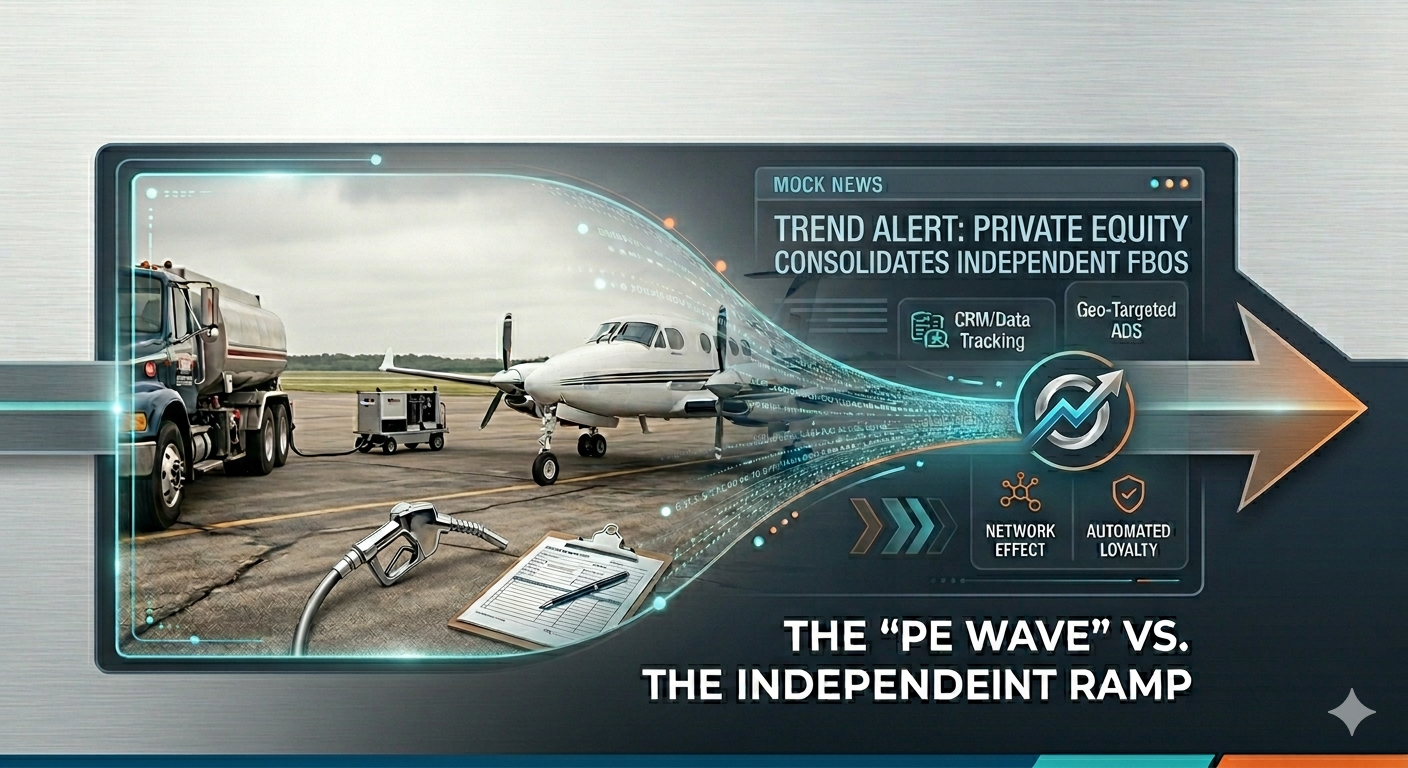
The news just hit the wire: Bain Capital has acquired APP Jet Center. With Mark Johnstone—the strategist who led Signature Aviation through its own massive growth—at the helm, this isn’t just a change in ownership for a few hangars in Manassas and Hayward. It’s a loud signal that Private Equity (PE) sees the FBO industry as a high-yield, supply-constrained real estate play.
At FBO Forward, we focus on helping the “underdogs”—the independent operators and smaller chains—stay competitive. When a giant like Bain enters the arena, the “standard” way of doing business is officially under threat.
Here is what this trend means for your ramp, and how you can use marketing and technology to hold your ground.
1. Awareness is No Longer About “Word of Mouth”
In the past, an independent FBO lived on its reputation. If you had good fuel prices and a friendly line tech, the pilots found you.
The PE Shift: Bain and other institutional owners don’t leave things to chance. They view “awareness” as a math problem. They invest in hyper-targeted digital advertising (Google Ads, Geofencing) to ensure that the moment a flight department starts planning a trip to your region, the “big chain” brand is the first thing they see.
- The Move: You cannot be invisible in 2026. If your website looks like it was built in 2005, you are telling modern flight departments you aren’t ready for their business. Awareness today is built through a professional digital “front door.”
2. The CRM Gap: Data vs. “Doing it by Memory”
PE firms are masters of the Customer Relationship Management (CRM) stack. When APP Jet Center integrates into the Bain/Johnstone playbook, they won’t just know a tail number; they will know the owner’s favorite catering, the pilot’s preferred hotel, and exactly when that aircraft is due for its next fuel uplift.
The PE Shift: They use data to create a “sticky” experience across their entire network. If a pilot has a great experience at one location, the CRM ensures that same “personalized” feeling is duplicated at the next—even if the staff has never met them.
- The Move: Stop keeping your customer notes in a binder or in the head of your CSR manager. Even a simple, well-managed CRM allows an independent to provide actual personalized service that feels human, not programmed.
3. Digital Friction: The “Seamless” Expectation
Modern crews and passengers are “Amazon-primed.” They expect to book services, check fuel prices, and confirm handling with three clicks on a mobile device. PE-backed chains have the capital to build proprietary apps and seamless booking engines.
The PE Shift: They are removing “friction.” If it’s easier to book with the chain than it is to call your front desk, the chain wins—even if your fuel is five cents cheaper.
- The Move: Audit your digital friction. Can a pilot request a fuel release or a rental car via your website easily? If not, you’re giving the big chains an easy win.
4. Brand Personality: The Independent’s Secret Weapon
Here is the good news: PE-backed chains often struggle with authenticity. As they standardize and corporatize, the service can start to feel “canned.”
The PE Shift: They scale through consistency, but they often lose the “soul” of the FBO in the process.
- The Move: Your marketing should scream local expertise. Use your social media and email newsletters to show off your team, your community, and the specific reasons why pilots love your specific tarmac. While the big guys are focused on the “platform,” you should be focused on the person.
The Bottom Line
The Bain/APP acquisition proves that the FBO industry is more valuable than ever. But as the “corporatization of the tarmac” accelerates, the margin for error for independents is shrinking.
You don’t need a Private Equity budget to win, but you do need a modern strategy. It’s time to move FBO Forward.
Is your digital presence ready to compete with the big chains?