
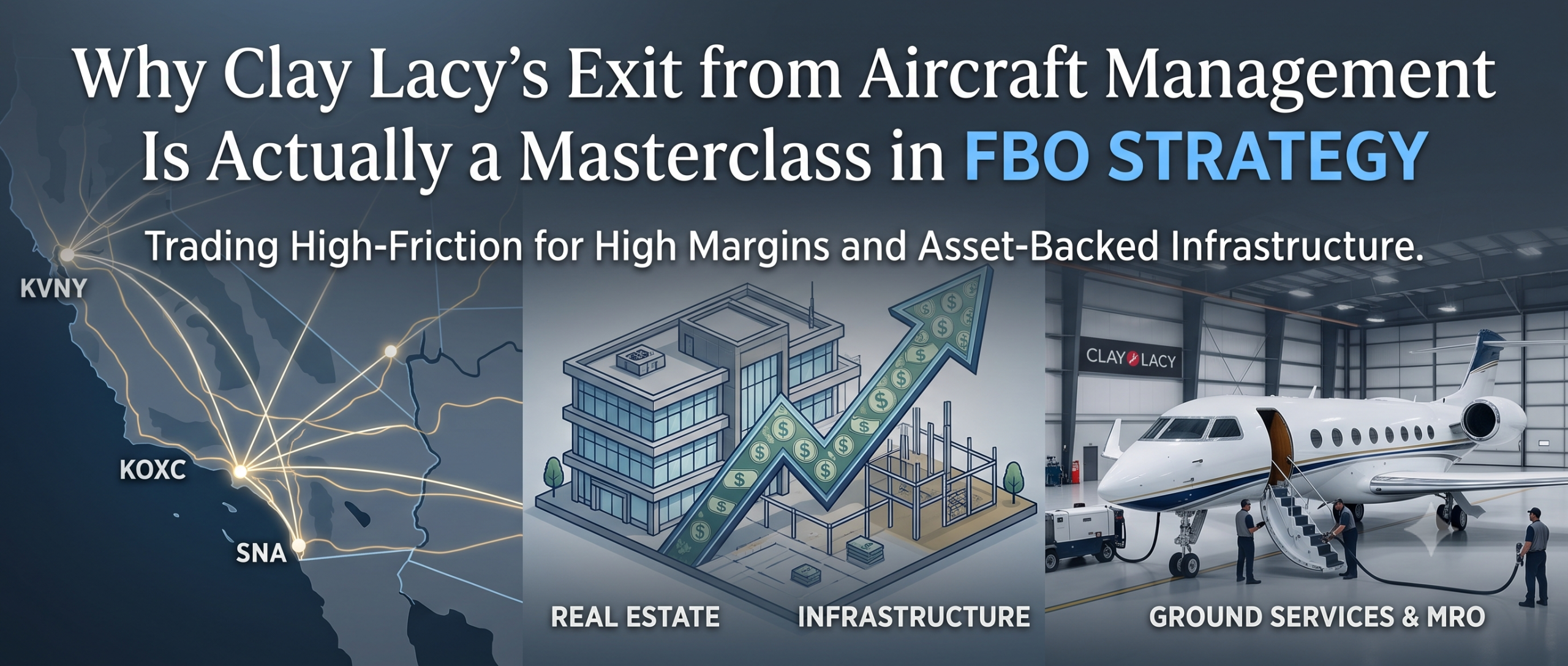
When Solairus Aviation announced its acquisition of Clay Lacy Aviation’s aircraft management and charter division—pushing Solairus’s fleet beyond 500 aircraft—the media headlines predictably focused on fleet consolidation. But for fixed-base operators, airport real estate developers, and aviation leaders, the most compelling strategic move wasn’t made by Solairus.
It was made by Clay Lacy.
Under the agreement, Solairus acquires the management contracts and operational side for ~160 aircraft. Clay Lacy retains 100% ownership of its premier FBO network, hangar facilities, MRO stations, and real estate assets across key hubs like Van Nuys (KVNY), Waterbury-Oxford (KOXC), and John Wayne Airport (SNA).
By shedding its managed charter fleet, Clay Lacy isn’t stepping back—it is executing a calculated pivot to double down on the highest-margin, most defensible segment of business aviation: airport infrastructure, fixed-base operations, and ground services.
Here is what this deal signals for the FBO market and why it’s a brilliant asset-backed strategy.
1. Trading High Friction for High Margins
Managing aircraft and running a Part 135 charter operation is an operationally intense business. It requires navigating constant owner relations, volatile pilot staffing markets, regulatory exposure, and notoriously thin operating margins.
In contrast, fixed-base operations and aviation real estate offer an entirely different financial profile:
- Higher Margin Profiles: Premium margins on Jet-A fuel throughput, ramp handling, and specialized Part 145 shop labor.
- Predictable, Recurring Cash Flow: Long-term lease agreements for hangar bays and private terminal office space.
- Lower Operational Risk: High asset protection without the scheduling logistics or liability of crewing and dispatching aircraft.
By unbundling aircraft management from facility ownership, Clay Lacy transitions its business model from an operational management firm into a high-yield aviation infrastructure and real estate engine.
2. Liberating Capital for Infrastructure Expansion
Clay Lacy has committed massive capital toward landmark infrastructure projects, including major developments at KVNY, KOXC, and SNA. Exiting aircraft management liberates significant capital and operational bandwidth, allowing leadership to focus resources where the returns are highest:
- Next-Gen Terminal CapEx: Accelerating investments in modern, luxury FBO terminals that attract premium transient aircraft.
- Ultra-Long-Range Hangar Capacity: Building wide-span hangars tailored to fit the newest generation of large-cabin jets (G700, Global 7500, Falcon 10X).
- Future-Proofing Ramps: Investing heavily in Sustainable Aviation Fuel (SAF) storage, ground support electrification, and advanced air mobility (AAM) infrastructure.
3. Retaining the Revenue Without the Overhead
In business aviation, proximity and service quality drive customer retention. Selling the management contracts doesn’t mean losing those aircraft as ground customers.
The majority of those ~160 aircraft remain based at or regularly operate out of Clay Lacy facilities. Through established location advantages and entrenched service relationships, Clay Lacy is positioned to capture the most lucrative part of the customer relationship: fuel sales, ramp fees, hangar rentals, and maintenance service revenue—all while Solairus takes on the management overhead, pilot payroll, and owner relations.
4. Winning the Real Estate Moat
As private equity drives consolidation in aircraft management—creating mega-management platforms managing 300 to 500+ jets—competing on sheer fleet count requires massive scale and ongoing capital investment.
However, airport ramp space is finite. You cannot duplicate prime leasehold land at high-density airports like Van Nuys or John Wayne. Clay Lacy recognized that its true competitive moat isn’t in competing for management agreements—it is in owning and operating the physical footprint on the field.
The Takeaway for FBO Operators
The Clay Lacy deal highlights a broader trend across business aviation: asset-backed infrastructure and high-yield ground services are outperforming operational management.
For FBO operators and aviation service providers, victory isn’t about chasing every segment of the value chain. It’s about owning the high-margin ground touchpoints, building an unshakeable ramp presence, and positioning your location as the preferred choice on the field.